In Part 1 of this series we made the case that your Google Business Profile is functionally your homepage — the page most local customers actually see, and the primary source Google’s AI uses to describe your business. This installment gets specific about the two fields that carry most of that weight: the business description, and the services and products you list.
Before writing it, we looked at 36 dealer profiles from our own network — a mix of U.S. and Canadian shops, storefronts and mobile operations, independents and multi-location groups. We searched each one the way a customer would: business name, city, on Google. What came back is the honest starting point for this MadicoU post.
What We Found
Ten of the 36 did not produce a Business Profile panel at all when we searched their name and city. In some cases the profile simply wasn’t there. In others it existed but was too thin for Google to show with confidence — one dealer’s profile turned up in the local results under a slightly different name than we have for the dealer, sitting on 10 reviews while two competitors in the same city held 911 and 293. One Canadian dealer had two separate listings for the same business: one categorized as auto window tinting with a single review, the other as a glass repair service with 76.
Of the 26 profiles that did show a panel, two had no description at all. Most of the rest had one — and that is where the real problem lives, because having a description and having a description that works are not the same thing.
We also noticed something worth watching, though we want to be careful not to over-read it: on a handful of profiles, Google was displaying its own AI-generated one-line summary of the business above the description. The two profiles in our sample with the most specific, well-structured descriptions had one. Several with vague or keyword-heavy descriptions did not. That is four data points, not a proven mechanism, and Google has not published what triggers these summaries. But the direction is consistent with everything else we know which is the more clearly you state what you do, the more comfortable Google’s systems are describing you.
The 250-Character Rule
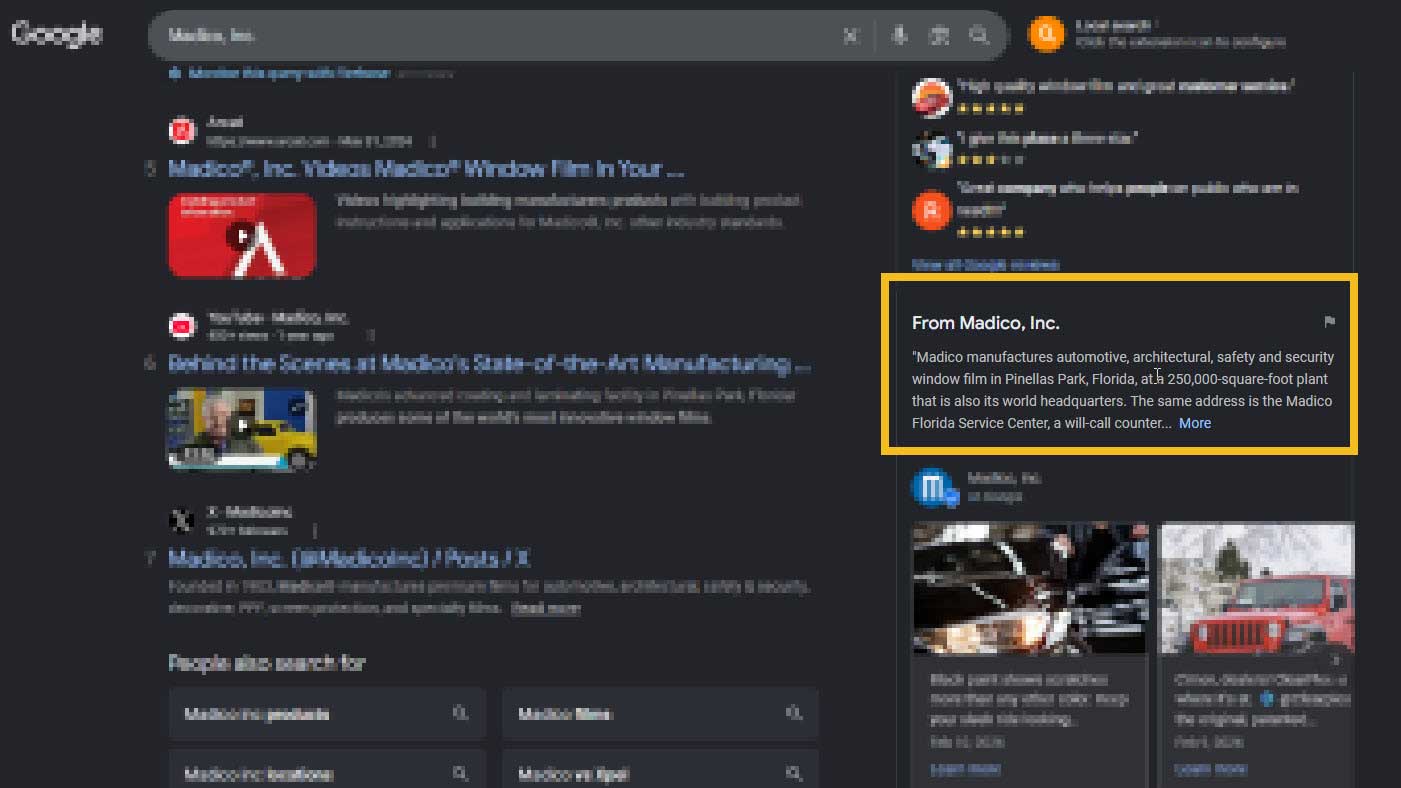
The description field allows 750 characters, including spaces. Only about the first 250 appear before the reader has to click “More.”
We confirmed this the hard way. When we pulled the profiles in our sample, nearly every long description came back cut off at almost exactly the same point — 246 to 253 characters — because that is what Google actually serves onto the page. The remaining 500 characters exist, but most people, and in practice most automated readers, encounter the first 250 first.
This single fact should change how you write. Your first two or three sentences are not an introduction to the good part. They are the whole thing. Everything after character 250 is a bonus for the small number of people who tap “More.”
The Keyword Myth, and Why It Costs You
Conventional advice says to write a keyword-rich description. This is the piece of the standard playbook we would push back on hardest.
Keywords in your Business Profile description do not affect your ranking. BrightLocal’s analysis of Google’s local algorithm lists “keywords in GBP description” explicitly among the factors that do not impact rankings. Your primary category is the single strongest lever on local pack ranking; your description is not a lever at all. Google’s own guidelines reinforce this from the other direction — the description is meant to convey services and products offered, along with the mission and history of the business, and Google prohibits links, promotional and pricing content, and low-quality or gibberish text.
So stuffing keywords into the description buys you nothing in rank, and it costs you the only 250 characters a customer will read.
Here is a real description from a dealer in our network, lightly trimmed:
“[Dealer] is a leading provider of commercial and residential window tinting, offering innovative security window film installation strategies near you. Trusted for your window tinting needs since 1991. As a recognized industry leader in security window film for privacy, we’re dedicated to our market leadership as a dealer and installer of the best commercial window tinting products available…”
The phrase “window tinting” appears four times before the reader gets to a single concrete fact. The one genuinely valuable detail — in business since 1991 — is buried in the second sentence and surrounded by filler. This shop has been doing good work for over thirty years, and its description tells you almost nothing about it.
A second example, from a dealer whose profile Google categorizes as a construction company:
“[Dealer] provides Shower Door Installation, Wind Walls, Glass Stairway, La Cantina Doors, Glass Replacement, Storefront, Window Film, Stainless Steel Restoration, Frame Restoration, Hard Water Removal, Sign Restoration, Building Painting services to the [City] area.”
Twelve services in one sentence, with “Window Film” seventh in the list. Nothing here tells a customer — or a machine — that this is a business worth calling about window film specifically.
What Good Actually Looks Like
Now compare a description which we think is the strongest in our sample:
“[Dealer] is a professional security glazing contractor serving the DFW Metroplex. We protect commercial properties, schools, houses of worship, and government facilities in Grand Prairie, Arlington, and Irving with … Security Window Film, Riot Glass impact-resistant panels, Crimsafe Security Screens, and Bullet-Resistant glazing systems — helping facilities deter forced entry and meet TEA safety compliance standards. We also provide commercial and residential window tinting for solar heat rejection, glare reduction, and privacy. Certified, insured, and trusted by DFW businesses since 2017.”
Read that first sentence again and notice what it does in under 100 characters: it names a specialty, a role, and a region. By character 250 the reader knows who they serve, which cities, and which product systems. Every clause is a fact a customer might search for or a machine might repeat. There is no filler — and, notably, not a single keyword repetition.
We are suggesting that dealers adopt this shift. Stop writing keyword-rich descriptions. Start writing sentences you would be happy to see quoted back to you.
Why “Quoted Back” Is the Right Test
That phrasing is deliberate. At BrightonSEO, Brad Wetherall showed a Philadelphia law firm whose Business Profile described it as a top-rated personal injury firm “with a reputation for winning big,” and as a female majority-owned firm. Google’s AI Overview for that firm came back describing a personal injury and mass tort practice with “a reputation for winning large settlements,” and listed it as majority-female-owned.
The AI did not invent those characterizations, and it did not find them by crawling the open web. It took the claims the business had written about itself and repeated them, lightly reworded. That is the mechanism. Your description is not marketing copy that Google evaluates; it is source material Google paraphrases.
Which means the practical question when writing yours is no longer “did I include my keywords?” It is: if Google repeated one sentence of this to a customer who has never heard of me, would it help?
A Structure That Works
For the first 250 characters, in order:
1. What you are, specifically. Not “window film company” — “commercial security film contractor,” “automotive tint and paint protection shop,” “residential solar control specialist.”
2. Who you serve and where. Name the cities and the customer type. “Homeowners in Naperville and Aurora.” “Property managers across the Gulf Coast.”
3. What makes you a safe choice. Years in business, certifications, manufacturer authorization, warranty. Facts, not adjectives.
Then use the remaining 500 characters for the specifics: named product lines, the segments you serve, and any credential that would matter to a cautious buyer.
Two things to avoid, because Google’s guidelines prohibit them outright: no links of any kind, and nothing about pricing or promotions. A description built around “call for our summer special” can get rejected.
Services and Products: The Field Most Dealers Leave Empty
The description is only half of this. Google also lets you list individual services, each with its own short description of up to 300 characters, and products with longer descriptions and images.
In our sample, roughly half the profiles with a panel had no product or service entries showing at all. This is the clearest unforced error we found, for two reasons. First, a blank services list forces Google to infer what you sell from your category alone. Second, these entries are the closest thing you have to telling Google’s AI, in structured form, “here are the specific jobs I do.”
Write each service the way a customer would name it, not the way the industry does. “Ceramic window tint for cars” will match more real searches than “nano-ceramic IR-rejection automotive film.” Then use the 300 characters to say what it is for, who it suits, and what changes for the customer afterward.
This matters most for mobile and service-area businesses. Nine of the profiles we looked at operate without a public storefront address. When you hide your address, your services list and description carry a much larger share of what Google knows about you.
On Performance Numbers
If you cite performance figures — solar energy rejection, UV rejection, glare reduction — pull them from the published specification for the exact film you install, and name that film. The product pages on madico.com carry the performance data for each line.
This is not a formality. The whole argument of this article is that Google’s AI repeats what you write, without a human checking it first. A rounded-from-memory claim like “blocks 99% of the heat” — 99% is the UV figure, and total solar energy rejection is nowhere near that — does not just sit quietly on your profile. It gets repeated back to customers as fact, attributed to you, and it is considerably harder to retract from an AI summary than from your own website. Precision here protects you.
An Honest Caveat
None of this will move you up the map pack by itself. Your description is not a ranking factor, and we want to make that clear. Category, proximity, reviews, and prominence drive ranking — and categories are where we are going next.
What the description and services list do is determine what happens after Google decides to show you: whether the customer understands what you do, and whether Google’s AI can describe you accurately to someone who never scrolls far enough to find you. That is a conversion and representation problem, not a ranking problem, and it is worth an hour of your time regardless.
One more limit worth stating: 36 profiles is a sample, not a census. It tells us what these problems look like and roughly how common they are. It does not tell you the exact percentage of our network with an empty services list.
What’s Next in This Series
• Choosing the right primary and secondary categories for tint, PPF, and flat glass work — the field that does drive ranking
• Building a steady review engine: volume, frequency, and how to ask
• Photos and videos: what Google’s multimodal AI can actually see in your images
• Measuring performance and benchmarking against local competitors
Dealer Takeaway
Open your profile and read the first 250 characters of your description out loud. If they could describe any window film company in North America, they are not doing anything for you.
Rewrite them so they name what you specialize in, who you serve, where, and why you are a safe choice — then fill in every service you actually offer. It takes about an hour. It is the highest-leverage hour you will spend on your profile this year.
Sources: Brad Wetherall, “The Knowledge Panel is Your New Homepage,” BrightonSEO San Diego; Google Business Profile help documentation on business descriptions (support.google.com/business/answer/3038177); BrightLocal, “Google’s Local Algorithm and Local Ranking Factors”; Madico product performance data (madico.com); Madico dealer profile audit, 36 profiles, July 2026.